Showing posts with label Plano Model Products. Show all posts

Saturday, August 31, 2019

Upgrading Model Die Casting's Gunderson 4700cf Covered Hopper

I grew up in the shadows of some of the largest grain silos in Texas. Back then they bore the names Union Equity and Far-Mar-Co, Continental and Louis-Dreyfus. Everywhere in Fort Worth were grain trains, some with hoppers all painted alike and some with cars in a rainbow of colors. Railroad owned cars were pretty boring to me then. What really caught my eye were the light blue, brilliant yellow, bright pink and deep orange elevator-owned cars. My first custom painted model was an Athearn ACF Centerflow covered hopper I painted baby blue and lettered with Herald King PR-43 in the Farmers Co-op scheme.

Eventually the railroad owned cars would grow on me, especially those of Burlington Northern. BN had a large fleet of covered hoppers from the pre-merger roads as well as several purchased new in the late 70s and early 80s. As the 80s wore on BN acquired covered hoppers from several co-ops and elevators as well as some castoffs from Conrail. The additions to the covered hopper fleet couldn't be painted fast enough, even without the large name and logo applied to the sides of the car.

As I was seeing the fleet change in the late 80s I only knew there were two different types of covered hopper: the ACF Centerflow type and the ribbed side Pullman-Standard type. I knew this because Athearn made models of both (a crude PS 4740 and an even cruder ACF 5250). I really didn't start to dive deep into the differences between covered hopper cars until I started modeling the Bottineau grain train in the early 90s. As I described in the blog on Bottineau, I quickly became aware of the many different prototypes out in the real world and started collecting models of them from Intermountain, Accurail and MDC Roundhouse when I could.

Original MDC Roundhouse Gunderson 4700cf Covered Hopper

The Gunderson 4700 covered hopper kit from Model Die Casting's Roundhouse line was something of a transitional model between MDC's earlier less detailed kits and the more detailed models that would be released later in the 90s. Compared to say MDC's open hopper or boxcar kits, there was a real effort made to create a kit that built into a fully decorated model that looked complete. This model didn't have an unpainted underframe or brake details. Everything was painted and the lettering was crisp. The molded on stirrups and ladder rungs compared favorably with the Accurail ACF 4600 covered hopper released around the same time. The model had good bones, but soon it was surpassed by better models of different prototypes.

Like the Accurail ACF 4600 covered hoppers, I managed to collect a handful of these MDC Gunderson 4700 covered hoppers through the 90s and early 2000s. By the time Athearn had released the Gunderson car in the RTR line it was heavily upgraded with etched running boards, new trucks with metal wheels, new brake details and fine stirrups and end ladders. When you put the RTR model next to the original MDC model the difference was obvious.

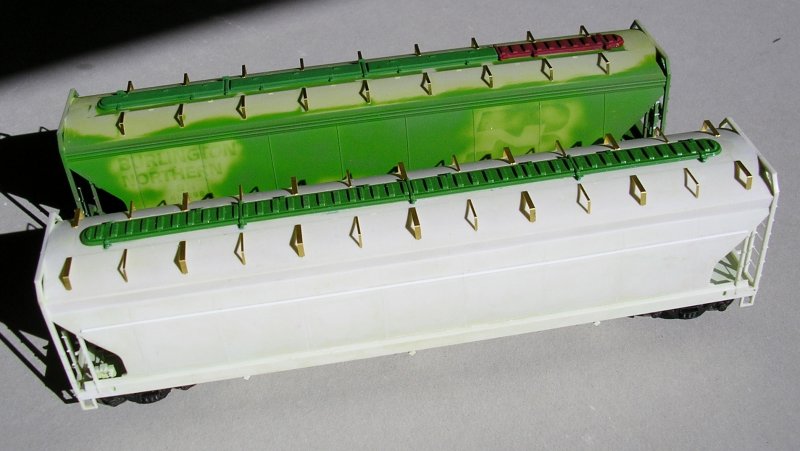
Original MDC Roundhouse model (left) compared to an upgraded MDC model (right)
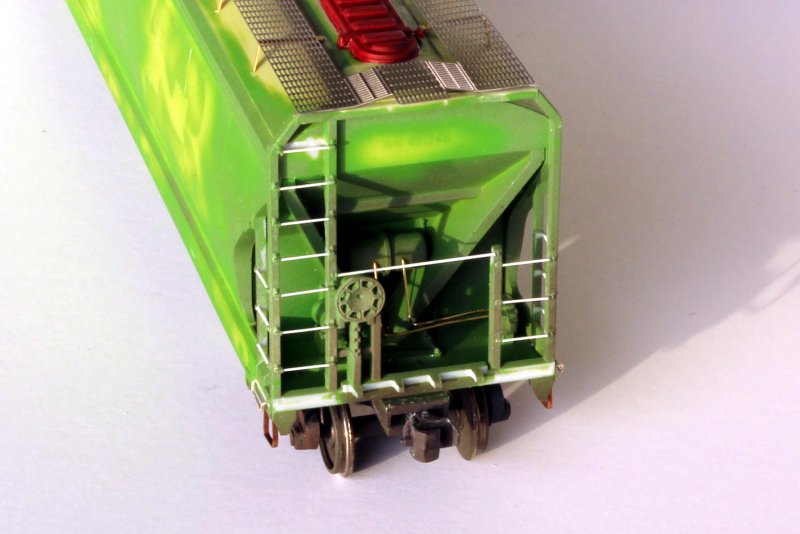
Athearn RTR model (left) compared to upgraded MDC Roundhouse model (right)

Rather than dispose of these older MDC models I decided to try upgrading them. Again, Plano Model Products came to the rescue with their etched running boards. Changing out the molded plastic running boards for the etched stainless steel part from Plano is the easiest thing you can do to improve the model. Unlike the Accurail model there's no carving or filing or sanding required, though you will have to fill in the holes where the original running board attached to the model. The Plano running board kits include brass supports that you bend and install on the model. The running boards can be installed later if you choose to paint the carbody but leave the running boards unpainted. The prototypes I'm modeling had the running boards painted the same as the carbody so I installed them before painting.
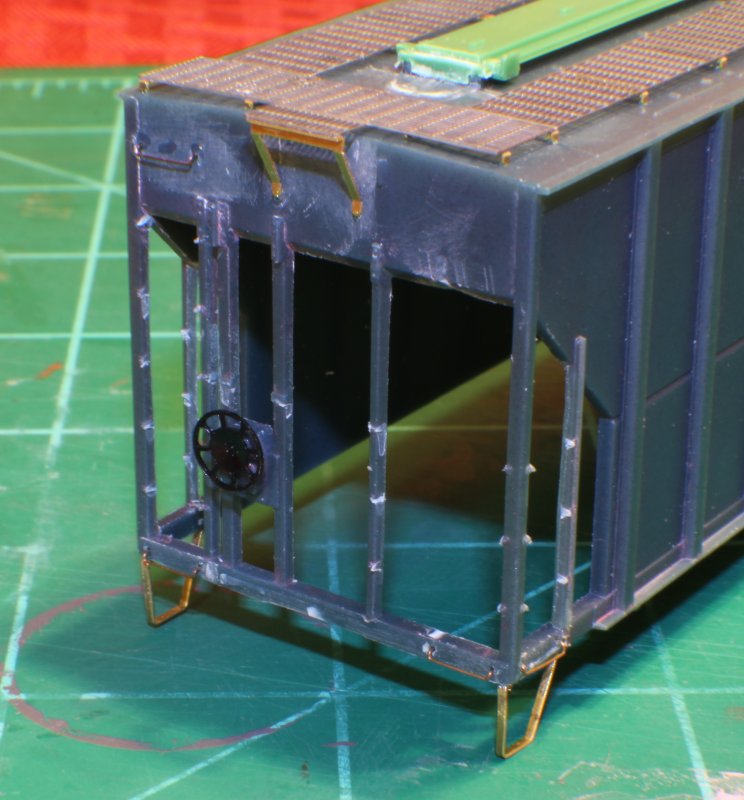


The stirrups can be replaced with A-line's Style B metal stirrups, but I decided to make some using 0.019" flat wire. Once the stirrups were bent to shape I drilled them for 0.012" brass wire pins and soldered them in place. The pins double as bolt heads visible where the stirrup mounts to the carbody.


Like the Accurail cars, I decided to replace all the cast-on ladder rungs with Plastruct 0.010" styrene rod. The grabs were replaced with Detail Associates parts on the first of these upgrade projects before I switched over to BLMA drop grabs. Since that time BLMA was purchased by Atlas, so I'm not sure if they are available anymore, but the point is moot since Tangent drop grabs are readily available and every bit as nice as the BLMA parts.

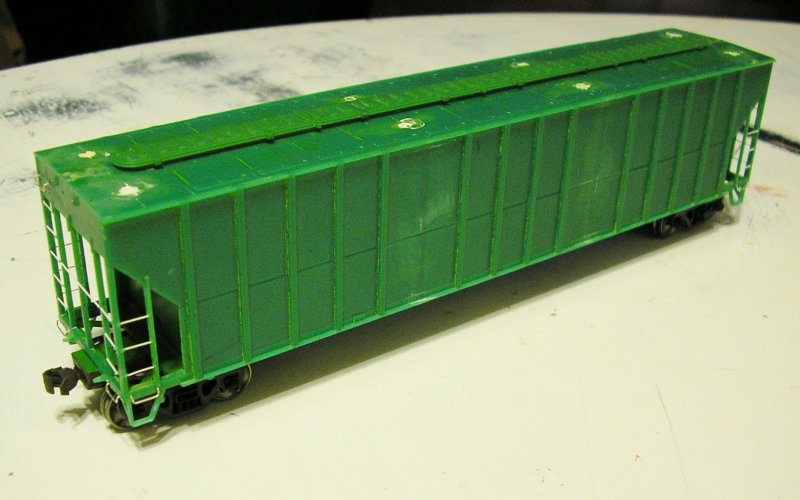

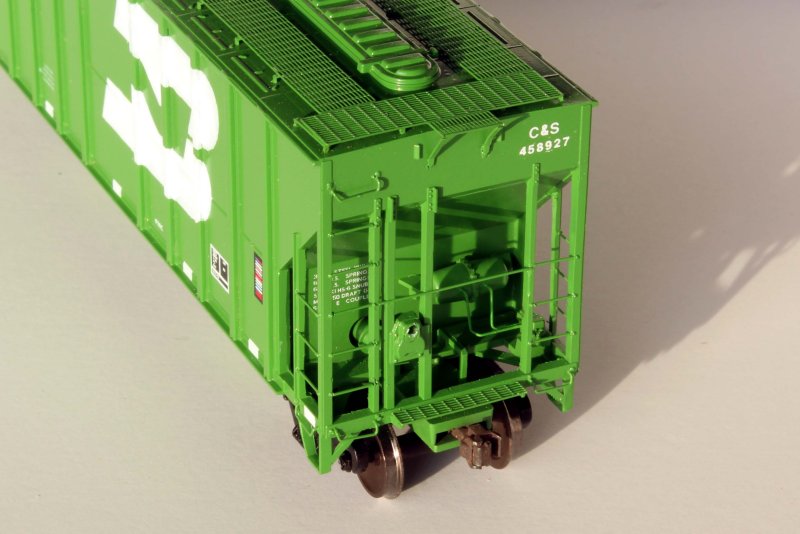
If you look at the sides of this model you can see I've removed two of the ribs creating a 5-4-5 rib pattern on the carbody side. This represents the predecessor to the Gunderson 4700, the 4692. The model pictured above was decorated as C&S 458927:


Still missing a brakewheel!

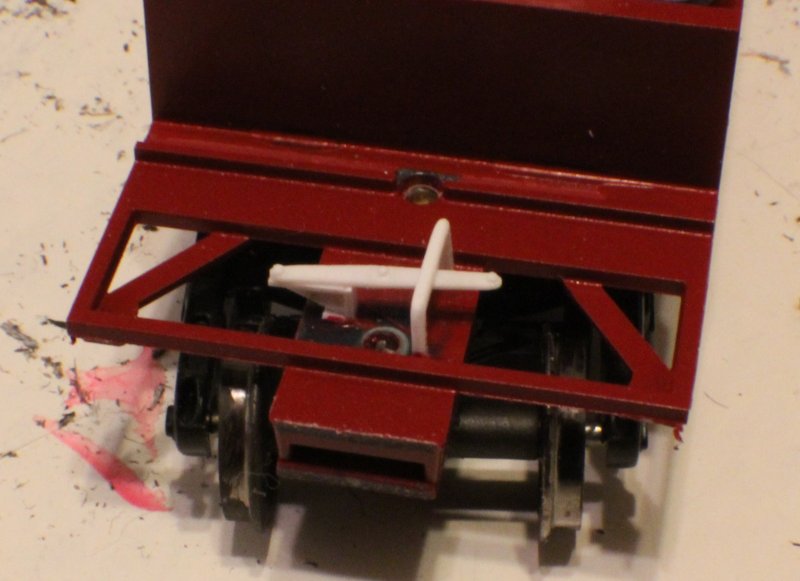
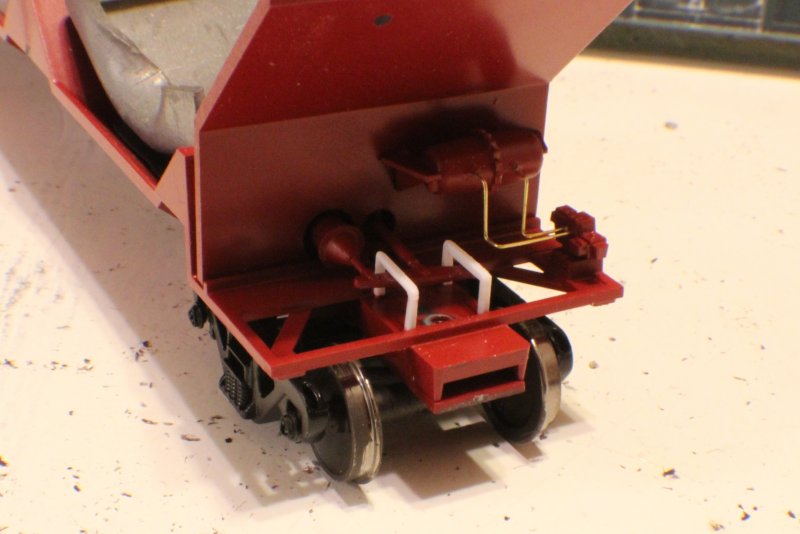
Besides the upgraded running boards and ladder rungs, I replaced the trucks and added some weight. I also plumbed the brake components with 0.012" brass wire and added some brake levers on the otherwise bare A end using the Athearn RTR model as a guide.


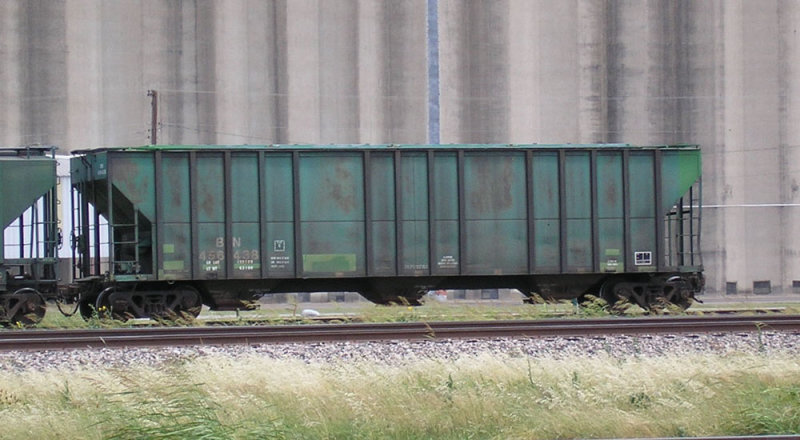
The model in red still isn't finished.... But when I finally get going on it again it will become BN 456438, a car I've managed to photograph twice:

BN 456438 in fresh paint on the right, Bottineau, ND July 1991
BN 456438 looking a little worn in Saginaw, TX May 2006

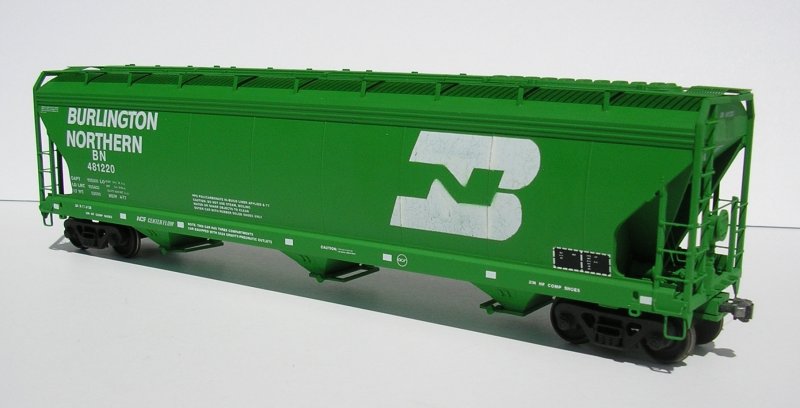
When Athearn finally offered these models upgraded in their RTR line, the plain green scheme wasn't available. Not being one to wait around for them to do it for me I repainted one myself:


I'm glad Athearn chose to take these cars to the next level. I've purchased several of the RTR models since. But I'm also glad they gave me a target to aim for as I tried to bring the older MDC Roundhouse version up to date. With a little work, these older models blend in quite well with the superdetailed models from Tangent, Scale Trains, ExactRail and Athearn Genesis.

Wednesday, August 28, 2019

Upgrading Accurail's ACF 4600cf Covered Hopper


For many years the only option to model an ACF 4600cf covered hopper has been Accurail's model. This model came along between the "shake-the-box" era of well-designed but marginally detailed models from the likes of Athearn and MDC Roundhouse and the early superdetailed era of much more detailed but complex and difficult to assemble kits from Intermountain and Proto2000.

The Accurail kits are neither superdetailed nor too basic. Even the molded on details are crisply rendered and can look good with weathering. But sometimes molded on detail just isn't good enough. I'll admit to using several Accurail cars as-is where I'm modeling unit grain trains, but for those cars that will be spotted and pulled from elevators and feed mills I'd rather have something a little more detailed.

Athearn Genesis released a very nice model of the ACF 4600 in several versions, so it's easy to get cars of this type that are already detailed and painted nicely. Arrowhead Models has also announced the ACF 4600 in what promises to be the ultimate fine detail version. The Athearn models can be found between $40 to $50 and the Arrowhead model will likely be priced above the Athearn model.

Accurail's ACF 4600 kit is comparatively cheap at $19.98 and it can be found even cheaper on the secondary market, such as at train shows and on ebay. I already had several of these on hand from many years before the Athearn release or Arrowhead announcement back when they were the only game in town, so in my case the cost was irrelevant. But if you're going to upgrade the Accurail model to fit in with similar models from Athearn Genesis, ExactRail or Scale Trains, keep track of the cost and decide if it's worth it to you. By the time you've upgraded the wheels, stirrups, grabs, running boards, paint and decals, you'll end up pretty close to the cost of the already upgraded Athearn model. So it's helpful if you already have the models on hand or can get them less than retail.


The worst part of the Accurail model is the molded on running board. It's not horrible, but it's solid plastic so no light shines through onto the roof. Fortunately, Plano Model Products has designed some products specifically for this model. And you can use Plano's part no. 119 with any of those running boards if you want to model an earlier car. I did exactly that for one of my pre-BN merger cars below. Even if you only replace the molded running boards with the etched Plano parts, you've made a huge difference to the model.

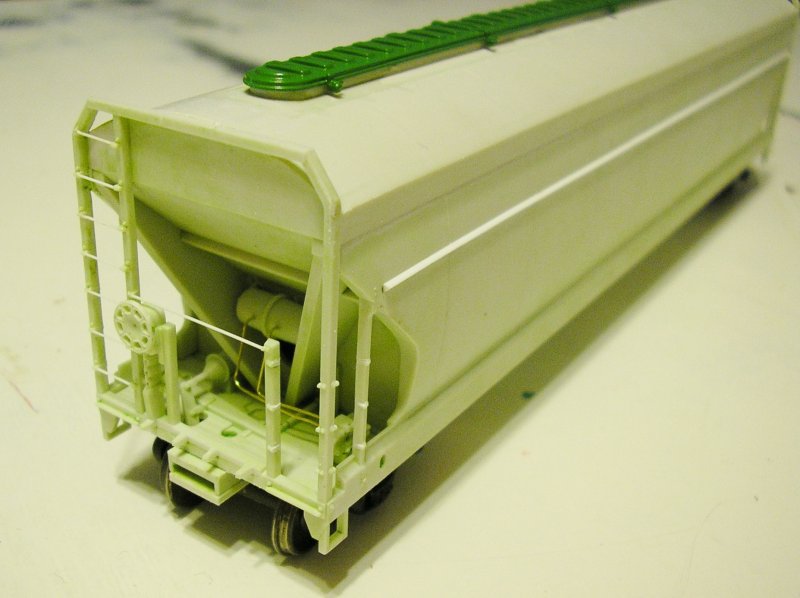
So the first step to replacing the running boards on the Accurail model is removing the molded parts. It's pretty easy to trim off the vast majority of the running boards using rail nippers. But you're still going to be left with the portion of the running boards that's in line with the trough hatch at each end. There's no easy way to remove that part except by sanding or filing or a combination of the two. I don't recommend carving this part off because you can easily gouge the roof. Instead, remove the trough hatch and set it aside, then start sanding taking care not to damage the end cage. You'll want to check periodically as you sand that you're following along with the profile of the roof as seen at the end taking care to match the contour under the trough hatch. Best practice here is to sand a little then check the model. Adjust where you're sanding and repeat. If you go too long you might find yourself having to build up the roof.


After the heavy work is done, clean up the rest of the roof where the supports were trimmed. Use the drill template from the Plano kit and install the supports. I like to attach the running board to the supports from the inside working outward toward the ends. I have always used Loctite liquid super glue, but lately I've started using DAP RAPIDFUSE. Either one works fine.


Another area you can address using the Plano kit is the crossover platforms. I like to carve the molded parts up into supports for the etched crossover platforms that are included in the Plano upgrade kit. A sharp no. 11 blade makes quick work of the solid crossover platform.

The ladder rungs on this model aren't as heavy as on some other models, but these are also easy to upgrade. First, using that sharp no. 11 blade, slice off the grabs taking care to run the blade along the inside of the ladder stile. Once all the ladder rungs are removed, cut Plastruct 0.010" styrene rod to length and attach using liquid plastic cement. Make sure the styrene rod lines up with the remaining ends of the molded ladder rungs still on the stiles.

It's also a good time to replace the cast on drop grabs at the corners with wire parts (I like the drop grabs from Tangent) and the stirrups with A-line's Style A part. If you like, plumb the reservoir using some 0.012" brass wire bent to fit between the reservoir and control valve.


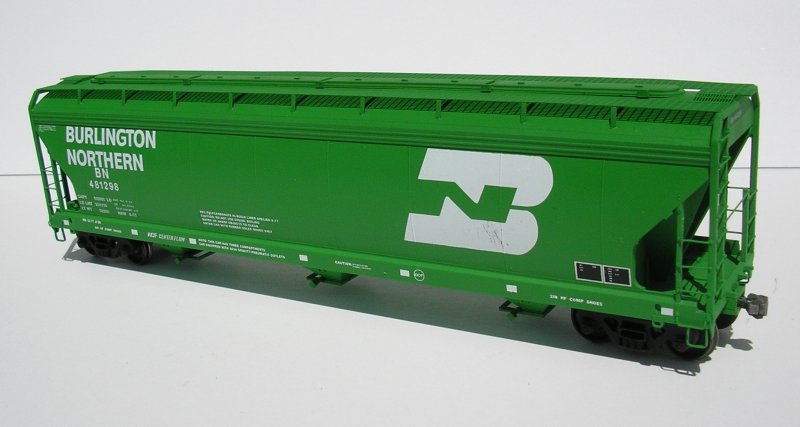
For these Burlington Northern cars the paint and decals are pretty straightforward. I damaged the BN logo on mine, but that's not really a problem since the cars I'm modeling were pretty well worn by the late 80s.


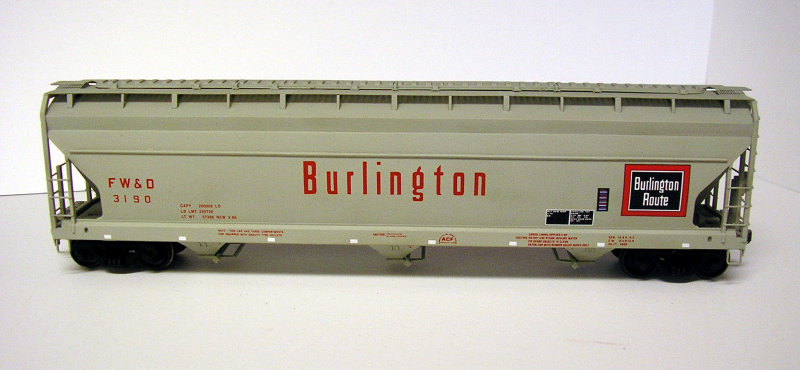
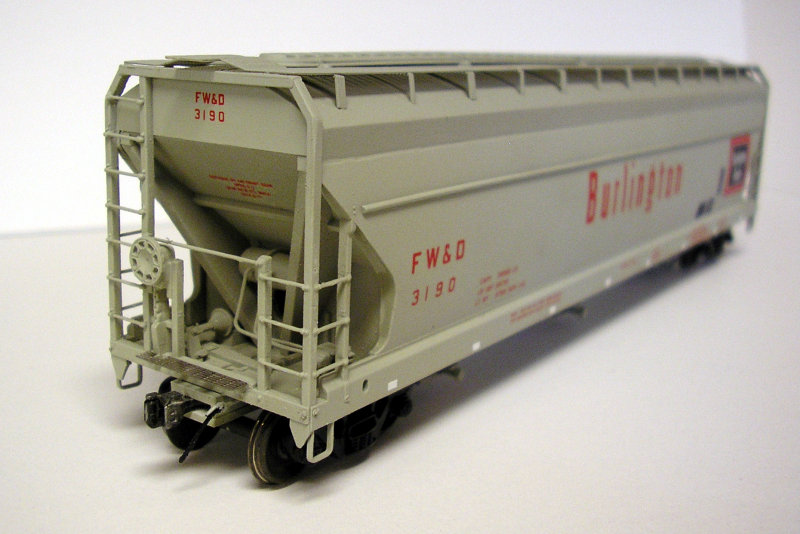
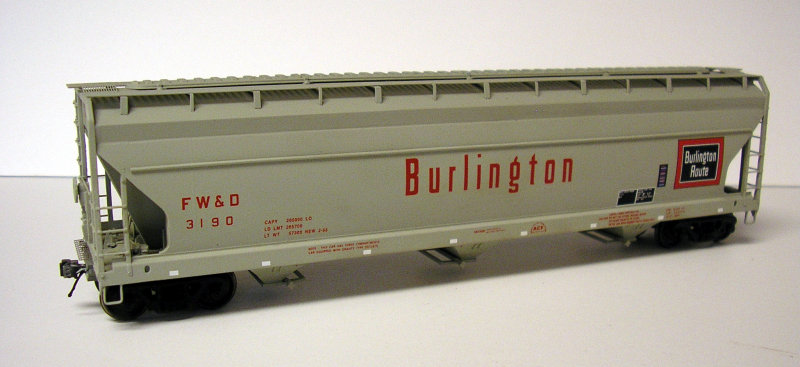
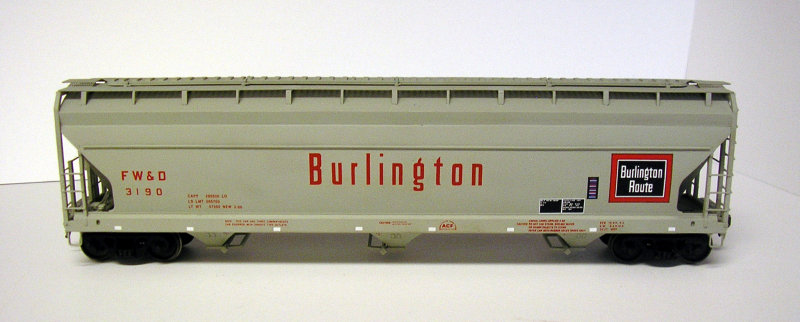
The Accurail ACF 4600 represents a late production model. Since Fort Worth & Denver is my home road, I also wanted to build one of their cars. This was made difficult because they are all of the early type with a single triangular stiffener rib on the carbody. The pressed plate that's present just under the car eaves on the Accurail model is correct for the late production model but it must be removed to represent an early model.


After those modifications were made, building this model was just like the others. I substituted the early style running board supports (Plano no. 119) for the supports included in the Plano kit. 

It's worth mentioning that I swapped the Accurail fiberglass type trough hatch with one from an Athearn (ex-MDC Roundhouse) Gunderson 4700 covered hopper. The hatch from the Gunderson hopper represents one of the early stamped metal trough hatches these cars were originally equipped with. 


The model was painted with Model Master Flat Gull Gray then lettered with Microscale decals. I haven't found a good match for the red-orange lettering and frame around the Burlington Route logo, but when I do I'll paint out the weight data and replace it per the prototype. 


I have a few more of these cars that are going to need similar upgrades. Santa Fe's ACF 4600 hoppers had Gypsum expanded metal running boards, which are thankfully available from Plano. I'd like to avoid repainting those cars, so I'll have to find a good match for the paint. But if that doesn't work out the one color dip paint job certainly isn't difficult to recreate.

Next time I'll go over some of the upgrades and modifications I made to MDC Roundhouse Gunderson 4700cf covered hoppers. MDC Roundhouse was acquired by Athearn, who later released these models as upgraded RTR versions and they are quite nice. It doesn't take much more effort than shown here to upgrade the older MDC Roundhouse kits to match Athearn's RTR model.